Landing in a new country should be exciting.
You've collected your luggage, passed through immigration, and you're finally ready to begin your trip.
For many travelers, the very first interaction outside the airport is with a taxi driver.
Most taxi journeys around the world are honest, professional, and completely uneventful.
However, tourist destinations also attract a small number of dishonest drivers who take advantage of visitors who are unfamiliar with local prices, routes, and transport systems.
The good news is that most taxi scams are surprisingly easy to avoid.
Once you understand how they work, you'll recognize the warning signs before they become expensive mistakes.
This guide explains the most common taxi scams around the world, how they happen, and the simple steps you can take to protect yourself—whether you're visiting Paris, Bangkok, New York, Rome, Dubai, Istanbul, Tokyo, or almost anywhere else.
Why Tourists Are Common Targets
Taxi scams don't usually happen because tourists are careless.
They happen because visitors often lack local knowledge.
When you arrive in a new country, you may not know:
- What a normal taxi fare costs.
- Which route is the fastest.
- Whether taxis use meters.
- If tipping is expected.
- Which taxi companies are officially licensed.
- How local payment systems work.
Scammers rely on this uncertainty.
Fortunately, a little preparation dramatically reduces your chances of encountering problems.
Most Taxi Drivers Are Honest
Before discussing scams, it's important to keep things in perspective.
Millions of taxi journeys take place every day around the world.
The overwhelming majority are completed without any issues.
Licensed taxi drivers provide an essential service, helping people reach hotels, train stations, hospitals, business meetings, and tourist attractions safely.
This article isn't intended to create fear.
Instead, it's designed to help travelers recognize the small number of situations where extra caution is worthwhile.
Being informed makes traveling more enjoyable—not more stressful.
Scam #1: "The Meter Is Broken"
One of the oldest taxi scams is also one of the most common.
After you enter the vehicle, the driver explains that the meter isn't working.
Instead, they suggest agreeing on a price.
The problem is that visitors rarely know what a reasonable fare should be.
As a result, they may unknowingly agree to pay two or three times the normal amount.
How to Avoid It
Before getting into the taxi:
- Check whether the meter is visible.
- Ask politely if it will be used.
- If local regulations require metered fares and the driver refuses, consider choosing another licensed taxi.
In cities that use fixed airport fares, confirm the official price before beginning your journey.
Scam #2: Taking a Longer Route
This scam is difficult for visitors to detect.
Instead of choosing the most direct route, the driver intentionally takes a longer journey to increase the fare.
Sometimes this involves unnecessary detours.
Other times, the driver may simply avoid faster roads.
For travelers unfamiliar with the city, everything appears normal.
How to Protect Yourself
Before your trip:
- Check the approximate distance between the airport and your hotel.
- Look at the estimated travel time using an online map.
- Follow the route on your phone if possible.
Minor differences are completely normal due to traffic, roadworks, or temporary closures.
Large, unnecessary detours deserve closer attention.
Scam #3: Fake Airport Taxi Drivers
After exiting the arrivals hall, you may hear someone asking:
"Taxi?"
Not every person offering transportation is operating a licensed taxi.
Unofficial drivers often wait inside airport terminals hoping to approach arriving passengers before they reach the official taxi rank.
While some simply charge inflated prices, others may not meet local licensing or insurance requirements.
The Safer Approach
Whenever possible:
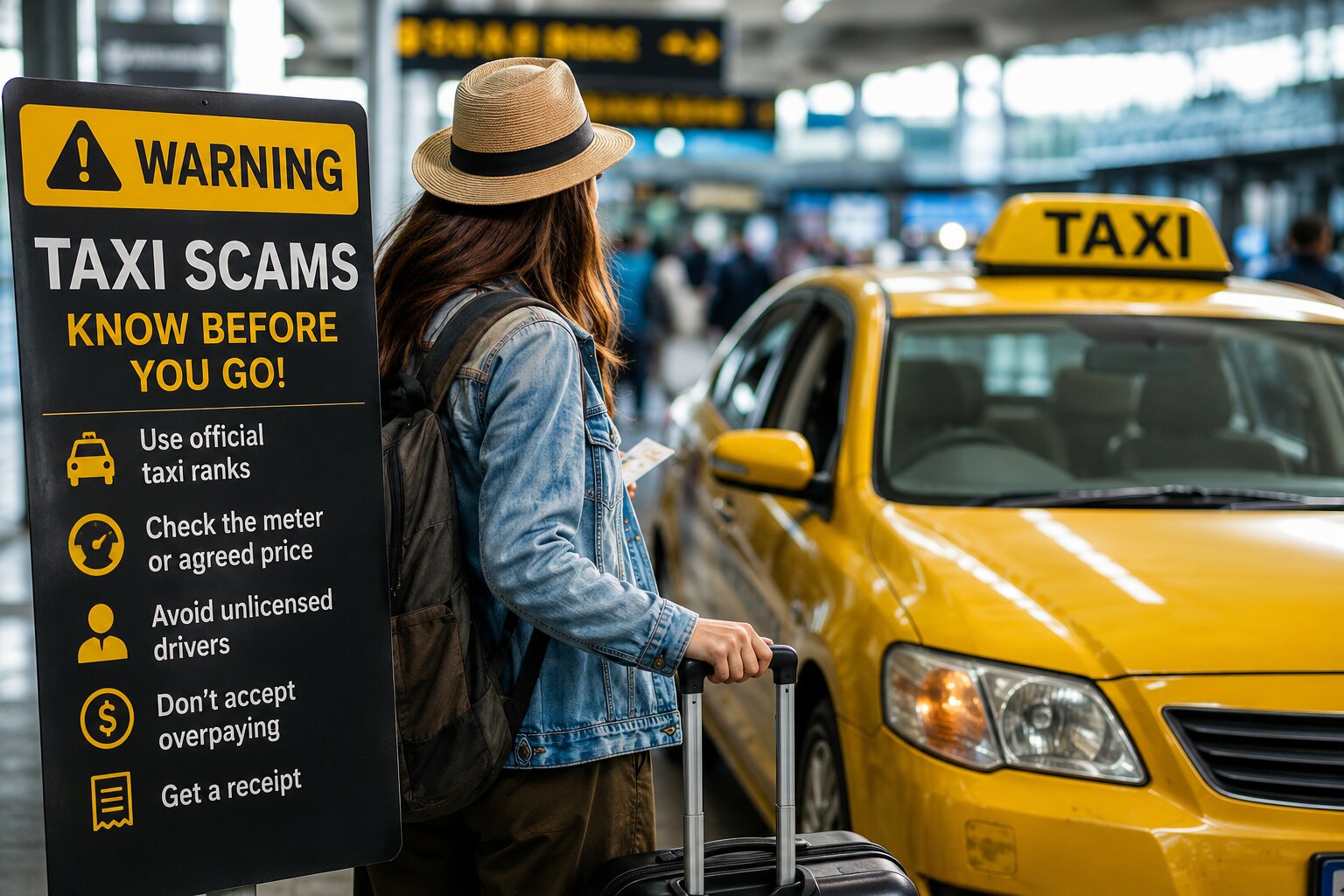
- Use the official airport taxi queue.
- Follow airport signs to licensed transportation.
- Ignore unsolicited offers inside the terminal.
- If you've pre-booked a transfer, follow the pickup instructions provided by your booking confirmation.
Official airport pickup procedures vary, but legitimate providers clearly explain where your driver will meet you.
Scam #4: The "No Change" Trick
At the end of the journey, you pay with a large banknote.
The driver claims not to have enough change.
Sometimes they genuinely don't.
Other times, it's a tactic to encourage you to accept receiving less money back than you're owed.
How to Avoid It
Whenever practical:
- Carry smaller banknotes.
- Ask whether card payments are accepted before the journey begins.
- Confirm the approximate fare in advance if it's a fixed-price route.
Having several payment options gives you greater flexibility.
Scam #5: Switching Your Banknote
This trick relies on speed and distraction.
You hand over a high-value banknote.
Within seconds, the driver claims you actually gave them a much smaller note.
Because the exchange happens so quickly, some travelers begin doubting themselves.
Stay One Step Ahead
When paying with cash:
- State the value of the banknote aloud before handing it over.
- Wait until the driver acknowledges it.
- Keep your wallet open until the transaction is complete.
This simple habit makes misunderstandings much less likely.
Expert Tip
One of the easiest ways to avoid transport problems is to spend five minutes researching local taxi rules before your flight.
Knowing whether your destination uses fixed fares, taxi meters, official airport ranks, or ride-hailing services gives you confidence before you even leave the terminal.
Scam #6: Counterfeit or "Broken" Card Machines
As card payments have become more common, so have scams involving payment terminals.
A driver may tell you at the end of the journey that the card machine is "broken" and insist on cash, even though you specifically chose a taxi because it accepted cards.
In more serious cases, dishonest operators may use unauthorized payment devices or attempt to charge the wrong amount.
How to Avoid It
Before the journey begins:
- Ask whether card payments are accepted.
- If possible, use contactless payments.
- Always check the amount displayed before approving the transaction.
- Keep the receipt until you've verified the charge.
Scam #7: Fake Extra Charges
Many cities have legitimate airport fees, toll roads, or nighttime surcharges.
Unfortunately, some dishonest drivers invent additional charges that don't exist.
Examples include:
- "Tourist tax"
- "Luggage tax"
- "Weekend fee"
- "Special airport exit fee"
- "Holiday surcharge"
Some destinations do have official surcharges, but they are usually clearly regulated and publicly available.
How to Avoid It
Before traveling, check whether your destination has:
- Fixed airport fares.
- Official toll roads.
- Night tariffs.
- Airport access fees.
Understanding the pricing structure makes unexpected charges much easier to question.
Scam #8: "Your Hotel Is Closed"
This scam has existed for decades.
During the journey, the driver tells you:
"Your hotel is closed."
Or perhaps:
"It's fully booked."
Then they offer to take you to "a much better hotel."
The suggested hotel often pays the driver a commission for bringing tourists there.
Even if the hotel is legitimate, it may be significantly more expensive than the accommodation you originally booked.
What You Should Do
If someone tells you your hotel is closed:
- Check your booking confirmation.
- Contact the hotel directly.
- Don't rely solely on the driver's information.
Hotels rarely close without notifying guests.
Scam #9: Unnecessary Luggage Fees
Some regions legitimately charge for oversized luggage.
Others do not.
Dishonest drivers sometimes take advantage of visitors by inventing baggage charges after the journey has ended.
Protect Yourself
Before loading your luggage:
- Ask whether baggage charges apply.
- If you're using an official airport taxi, check the published tariff where available.
Knowing the rules beforehand avoids awkward conversations later.
Scam #10: Starting the Meter Too Early
In some cases, the taxi meter begins running before you've entered the vehicle.
By the time you sit down, the fare has already increased.
Simple Solution
When entering the taxi, glance at the meter.
It should normally begin at the standard starting fare established by local regulations.
If the amount already seems unusually high, politely ask for clarification before the journey begins.
Scam #11: Taking Advantage of Language Barriers
Traveling somewhere you don't speak the local language can make even simple situations feel more complicated.
Some dishonest drivers exploit this by:
- Claiming they misunderstood the destination.
- Pretending not to understand payment questions.
- Miscommunicating agreed prices.
- Insisting a different route is necessary.
Reduce Misunderstandings
Save your destination address on your phone.
Better still, show the address written in the local language if possible.
Many hotel booking confirmations include this automatically.
Scam #12: Offering "Special Tourist Tours"
During the journey, the driver may suggest stopping at:
- Jewelry stores.
- Carpet shops.
- Souvenir markets.
- Tailors.
- Spice stores.
While some recommendations are genuine, others are commission-based stops where the driver earns money if tourists make purchases.
What to Remember
If you want a sightseeing tour, book one intentionally.
If your goal is simply reaching your hotel, politely decline unexpected shopping detours.
Scam #13: Refusing Short Journeys
In busy tourist areas, some drivers prefer longer, more profitable trips.
As a result, they may refuse passengers traveling only a short distance.
Your Options
If this happens:
- Join the next official taxi in the queue.
- Use a licensed ride-hailing service where available.
- Walk only if the distance is short and you're comfortable doing so.
This situation is frustrating, but it's usually resolved quickly by choosing another vehicle.
Scam #14: Fake Ride-Hailing Drivers
Outside major airports, some individuals approach travelers claiming to be their ride-share driver.
Instead of using the official app, they attempt to persuade passengers to cancel their booking and pay them directly.
Stay Safe
Always confirm:
- The driver's name.
- Vehicle registration.
- Vehicle model.
- Pickup location shown in the app.
Never enter a vehicle that doesn't match your booking details.
Scam #15: Pressure to Pay Immediately Without Checking
After a long journey, many travelers simply want to reach their hotel.
Dishonest drivers sometimes rely on this fatigue by encouraging passengers to pay quickly without reviewing the fare.
Take Your Time
Before completing payment:
- Check the displayed fare.
- Confirm any additional charges.
- Request a receipt if available.
- Verify the card terminal amount before approving payment.
Rushing at the end of the journey is when small mistakes—or intentional overcharges—are most likely to happen.
Universal Safety Tips for Taxi Travelers
No matter where you're traveling, these habits dramatically reduce your chances of encountering problems.
Use Official Taxi Services
Choose licensed taxis from official ranks whenever possible.
They're generally easier to identify and operate under local regulations.
Research Typical Fares
You don't need to know the exact cost.
Simply understanding whether a journey usually costs around €20 or around €80 gives you valuable context.
Share Your Journey
If traveling alone, consider sharing your live location with a trusted friend or family member.
Most smartphones make this quick and easy.
Trust Your Instincts
If something doesn't feel right before the journey begins, choose another taxi.
It's perfectly acceptable to walk away politely.
Stay Calm
Even if a disagreement occurs, remaining calm is almost always the best approach.
Most misunderstandings are resolved through polite communication rather than confrontation.
Taxi Safety Is Mostly About Preparation
Contrary to popular belief, avoiding taxi scams doesn't require becoming an expert traveler.
It simply requires spending a few minutes preparing before your trip.
Knowing:
- how taxis operate,
- typical fares,
- payment methods,
- and local transport rules
gives you confidence from the moment you arrive.
Preparation is almost always your strongest defense.
Frequently Asked Questions
Are taxi scams common?
No. The vast majority of taxi journeys around the world are completed safely and honestly.
However, popular tourist destinations occasionally attract individuals who take advantage of visitors unfamiliar with local transport systems. Knowing the most common scams helps you recognize warning signs without becoming overly cautious.
How can I tell if a taxi is official?
Although requirements vary by country, licensed taxis usually have:
- Official registration or license plates.
- A visible taxi sign.
- Driver identification.
- A working taxi meter (where required).
- Company branding or local authority markings.
When arriving at an airport, it's generally safest to use the official taxi rank or a pre-booked transfer service.
Should I use cash or a credit card?
Both payment methods have advantages.
Cards reduce the need to carry large amounts of cash and provide a record of the transaction.
Cash can be useful in destinations where electronic payments are less common.
Whichever method you choose, confirm the accepted payment options before the journey begins.
Is it safe to use taxis at night?
In most destinations, yes.
Choose licensed taxis, avoid accepting rides from people who approach you unofficially, and share your trip details with someone you trust if you're traveling alone.
If possible, wait in well-lit, busy pickup areas rather than isolated streets.
What should I do if I think I've been overcharged?
Stay calm and ask the driver to explain the fare.
Many situations result from misunderstandings rather than intentional scams.
If you still believe something is wrong:
- Request a receipt.
- Note the vehicle registration.
- Record the driver's identification if visible.
- Contact the taxi company or local transport authority if necessary.
Having accurate information makes resolving disputes much easier.
Are ride-hailing apps safer than taxis?
Both licensed taxis and reputable ride-hailing services can provide safe, reliable transportation.
The best option depends on local regulations, availability, and your destination.
Regardless of which you choose, always verify the vehicle and driver details before entering.
What's the safest way to travel from an airport?
For most travelers, the safest options are:
- Official airport taxi ranks.
- Licensed airport shuttle services.
- Pre-booked private transfers.
- Well-established ride-hailing services where permitted.
Avoid accepting transportation offers from individuals approaching you inside the terminal unless they are clearly identified as your pre-arranged driver.
Taxi Scam Prevention Checklist
Before your next trip, spend a few minutes preparing.
✔ Research the typical taxi fare to your destination.
✔ Learn whether local taxis use meters or fixed fares.
✔ Save your hotel address offline.
✔ Keep your phone charged.
✔ Carry more than one payment method.
✔ Use official taxi ranks whenever possible.
✔ Confirm the driver's details if using a ride-hailing app.
✔ Check the route on your phone if practical.
✔ Keep your valuables with you at all times.
✔ Trust your instincts if something doesn't feel right.
These simple habits significantly reduce the chances of encountering problems.
Taxi Advice for Popular Tourist Destinations
Every destination has its own transport system, but the same basic principles apply almost everywhere.
European Cities
Many European cities regulate taxi prices carefully.
Official taxis are usually easy to identify, although airport fares may include fixed rates or regulated surcharges.
Always check whether your destination uses metered or fixed pricing before you arrive.
Southeast Asia
Ride-hailing apps are widely used in many cities alongside traditional taxis.
Where metered taxis are available, ask for the meter to be used if local regulations require it.
Knowing the approximate fare beforehand can also be helpful.
North America
Most taxis are licensed and regulated by local authorities.
Payment by credit card is widely accepted, although it's still worth confirming before the journey begins.
Busy airports may also have designated pickup areas for ride-hailing services separate from taxi ranks.
Middle East
Many airports offer well-organized official taxi services with regulated pricing structures.
Some destinations also have highly developed ride-hailing networks, giving travelers several reliable transport options.
Researching your destination before arrival helps you choose the service that best suits your needs.
Expert Recommendations
Experienced travelers rarely avoid problems because they're lucky.
They avoid problems because they prepare.
Before every trip:
- Learn how local taxis operate.
- Understand the pricing system.
- Save your destination address.
- Know where official taxis are located.
- Keep important phone numbers easily accessible.
These small steps take only a few minutes but can save considerable time, money, and stress after landing.
The goal isn't to be suspicious of every driver.
It's simply to travel with confidence.