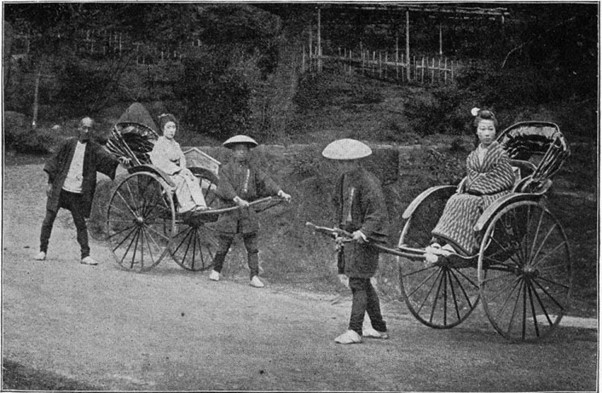
Every part of the world has their own take on taxis. Yes, we find the classic yellow cab all around the world, although in some cases they differ in colour. However there are some places where classic transportation has resisted the test of time, not because of it’s convenience but because of the cultural value it holds for locals and the Japanese rickshaw is certainly one of them. However, before getting to the question at hand, we must understand the definition of a taxi in order to get the idea that is pushed forward.
What Is a Taxi?
Where did
the word Taxi come from? Many may think it was created by someone but it’s
origin actually came from the part that kind of defines a taxi and that is the
taximeter. This device was created in the late 19th century Europe
and it’s use was to measure the distance and time of a ride in order to result
in a fare that had to be paid by the passenger. In this way the government as
well as the passengers, knew they were paying a fair price for their ride and
they were not hustled by the drivers.
Transportation
services have been known to exist since the early 18th century
around Europe, but these were never professional, available or most importantly
mattered. Interestingly enough, the name taximeter is not the name of the
inventor, but the combination between the Latin word “taxare” which means “to
charge” or “to assess” and the Greek word “metron” which translates to
“measure”.
The first
term to describe a taxi was actually taxicab that was used when the taxi became
popular. With time people have shortened the word to simply taxi.
The
Origin of Japanese Rickshaws (Jinrikisha)
Better known
by locals as the jinrikisha, this Japanese rickshaw is different because it’s
engine is 1 human power. That is because an actual human is pulling the
vehicle. Before the common use of horses as a mode of transportation, Japan
adapted these vehicles as they seemed more elegant. These were mainly used by
rich people or royalties in big cities as it was more clean and nicer smelling
than the use of a horse or other animal.
Invented in
1869, this human-powered vehicle revolutionised the transportation industry in
Japan, making it cleaner, safer and opening a big job market for common folk.
The word jinrikisha actually translates exactly to “human powered vehicle”.
These “taxies” were used on set routes, so the passenger would say they would
want to go to the bank for example and they would pay the fee before the ride
as it was an exact fee.
As you can
imagine, the limit of distance was high as it was only powered by one human,
however do not be fooled as these guys used to walk even 80 kilometres per day
whilst pulling a 50kg cart with another human weighing the same amount. Pulling
100 kilograms per day must have been a tough workout.
Were
There Taxis Before Rickshaws? A Global Comparison
To answer
the question in simple terms, we cannot consider Japanese rickshaws as the
first taxis in the world and not necessarily because they were seen as without
a taximeter, but because of their age. It is a fact that horse drawn hackney
carriages in London appeared at the start of the 1600s, making them sort of the
first hired transportation mode. Despite the engine used to push people around,
they would still transport people. The only difference we have is that the
taximeter was still not invented which lead to the meaning of a taxi as a mode
of transportation.
If we go
based on timeline we can say that London has seen the first taxis in theworld. If we go by mode of transportation and the evolution of transportation
we can argue that Japan were the first, but I bet some caveman thousands of
years ago came with the idea first.
Why
Rickshaws Are Still Considered a Milestone in Taxi History
The most
important take away from this article is that the jinrikisha is considered more
of a cultural phenomenon rather than a classic means of transportation. Most of
them can still be found around major Japanese cities such as Tokyo or Kawagoe. Today
they most offer tourist rides of the cities and they are a must for those who
go to Japan and want to taste some of their pre-modern culture and means of
transportation.
In true
meaning, the Japanese rickshaw is more than just culture, but it is something
that reformed Japan for the better. It had a major impact in it’s economical
system because it created many jobs. These also created the foundation for
later taxi systems in Japan and offered an affordable means of transportation.
This was also the era when Asia started their on technological revolution in
the means to catch up to the rest of the world, now we see Japan as a main hub
of technology.
Conclusion
In the end,
Japanese rickshaws hold an important place in the history of urban transport,
but calling them the very first taxis in the world is not fully accurate. They
were one of the earliest organized systems where people paid for short-distance
travel within a city, which makes them very similar in function to taxis.
However, hired transport services already existed in Europe centuries earlier,
such as horse-drawn carriages for hire. What makes rickshaws special is how
widely they were used, how structured the service became, and how they shaped
daily mobility in fast-growing cities in Asia.
The modern
idea of a taxi developed later, especially after the invention of the
taximeter, which introduced standardized fare calculation. This is also where
the word “taxi” comes from. So, while Japanese rickshaws were not the first
taxis in the strict technical sense, they were a major step in the evolution of
for-hire passenger transport. They represent a key bridge between traditional
human-powered travel and the regulated, motorized taxi systems we know today.